Inside the Langjokull Ice Tunnel: What You Walk Through at 1,260 Metres
The short answer
The tunnel inside Langjökull is cut by machine, not formed by meltwater, and its entrance sits at around 1,260 metres above sea level. Inside it is about 0 °C — warmer than the air outside it in January. The walk takes about an hour on level ground with crampons provided, there is no minimum age, and you reach it in an eight-wheeled glacier truck from Húsafell.
Getting to the door is half of it
You check in at the Húsafell activity centre, next to the bistro and the petrol station, and from there the day is a sequence of increasingly serious vehicles. A bus or a modified truck carries you up the mountain road to the Klaki base camp. At the camp you change to the glacier truck: eight wheels, a ladder rather than a step, and a cabin built to be warm at walking pace.
The last stretch is the one people remember. The truck crosses the ice cap itself for the best part of an hour, and in flat light there is nothing to fix your eye on at all. One traveller describes arriving at the entrance in complete whiteout. Another was snowed on in August. Both were where they should have been; that is simply what 1,200 metres does.
The entrance
The door is a dark rectangle in a white slope, and it looks smaller than you expect because there is nothing beside it to give it scale. Crampons go on here, over whatever you arrived in. From this point the floor is ice.
The first few metres are the coldest part of the whole visit, because the wind still reaches in. Twenty paces further and it stops entirely.
The main corridor
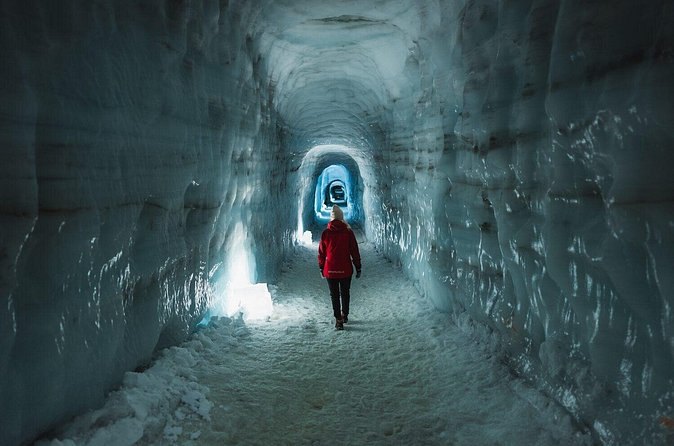
The tunnel runs level, wide enough for a group to walk two abreast, and it is lit from within the walls rather than from overhead. That is the detail nobody photographs well: the light is inside the ice, so the blue you see is the ice itself doing the colouring rather than a lamp being pointed at it.
Look at the walls rather than along the corridor. The ice is layered in bands, each one a year's snowfall compressed by the weight of everything laid down after it, and the darker seams between them are ash. Iceland being Iceland, several of those seams have names and dates.
The crevasse windows
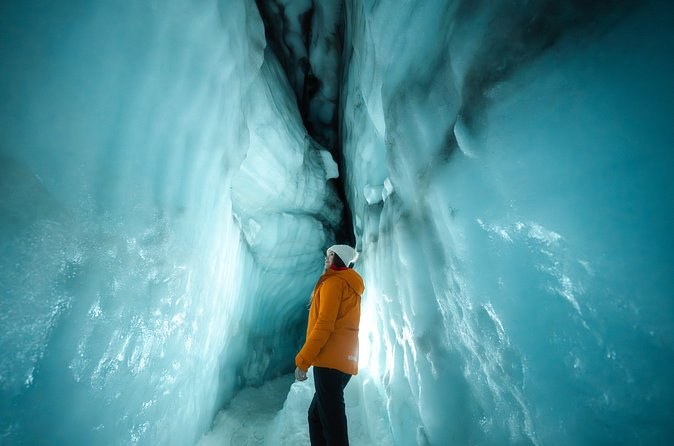
At intervals the corridor opens onto a crevasse — a natural split in the glacier that the tunnel intersects rather than creates. These are the moments that make the difference between a corridor and a glacier. You are looking into a crack that goes down further than the light does, and it was there before anybody cut anything.
Guides stop here, and it is worth asking what the crevasse is doing rather than just photographing it. The answer is the whole story of why nobody walks onto this ice cap unaccompanied.
The chapel
There is a chamber off the main corridor that has been used for weddings, with a carved ice recess at one end. It is smaller than photographs suggest and it is genuinely odd to stand in: a room with no material in it except frozen water.
The moment the lights go out
At some point in the visit the guides switch everything off. What is left is not darkness but a very faint blue, because daylight is coming through several metres of ice from above and arriving as almost nothing.
One traveller remembers a guide singing an Icelandic lullaby in that dark. Another says plainly that it was the best minute of the trip. It is the one part of the tour that cannot be photographed at all, which may be why everybody remembers it.
What it is like underfoot, and what to wear
| What | Inside the tunnel | On the surface outside |
|---|---|---|
| Temperature | Around 0 °C | Well below in winter, near freezing in summer |
| Wind | None | The reason a day gets cancelled |
| Ground | Ice, uneven and slushy in places | Snow |
| What you need | Crampons, provided | Waterproof outer layers |
The tunnel operator is specific about footwear: bring something water-repellent, because crampons go over your own shoes and nobody hands you a pair of boots. Layers matter more than a single thick coat, since you will be in and out of a heated cabin several times. The full kit list is on visitor information.
Who cannot do this comfortably
The operator's own answer is direct and worth repeating. The ground inside is uneven and slushy, and boarding the glacier truck means climbing five steps of about 40 centimetres. That is the real barrier, and it is the truck rather than the tunnel.
Beyond that the walk is easy: an hour, level, at a pace set by the slowest person. It sets no minimum age, which makes it the one glacier activity here that a family with a toddler and a grandparent can do together. The things to do page compares it with the alternatives.
How long the whole thing takes
- From the Klaki base camp: about 2 to 3 hours.
- From Húsafell: about 3.5 to 4 hours — the usual choice.
- From Reykjavik: about 9 to 11 hours, most of it road.
Those are the operator's own figures. If you are staying in the capital and want the tunnel rather than a day out, driving yourself to Húsafell and joining there turns an eleven-hour day into a four-hour one.
What the guides do while you are in there
A tunnel tour is not a walk with somebody counting heads. The guiding is the reason the hour holds together, and it covers three things: what the ice is doing, what Iceland did to end up with an ice cap at this latitude, and the folklore, which on this island is never far away.
Travellers name their guides in the reviews more often than they name anything else on the day. One remembers being told the story of the glacier's own name; another remembers a guide switching off every light and singing. If you have questions, this is the hour to ask them, because the group is small enough that you will be heard.
Photographing something lit from the inside
Two things catch people out and both are fixable. A whiteout on the way up gives an automatic camera nothing to focus on, so if the truck stops on the ice, focus on a person or a vehicle rather than on the horizon.
Inside, the light comes through the ice rather than from a lamp, and any automatic exposure will read the scene as bright and underexpose it. Overexpose by a stop and the blue arrives. Several of these tours have guides who take the pictures for you, and the results are usually better than the ones taken from waist height with a cold hand.
Is it a real ice cave?
It is real ice and it is not a cave. Nothing about that should put you off, and the distinction is the reason the thing exists: a natural ice cave under Vatnajökull forms in autumn, is visited in winter and melts out in spring, whereas this tunnel is engineered, lit, maintained and open in every month of the year.
If you are in Iceland in July and you want to be inside a glacier, this is the one you can book. The two are compared in full on Langjokull vs Vatnajokull, and the fares that reach the tunnel are gathered on Langjokull Tours.
Next step: the tunnel is sold with the transfer and the guide in one fare, and both versions are listed on Langjokull glacier tour pricing.
Tours that go inside the ice
Into the Glacier: Langjokull Glacier Ice Cave from Husafell
An hour inside the tunnel at 1,260 metres, entry fee in the fare.
From $203 per person
Check Availability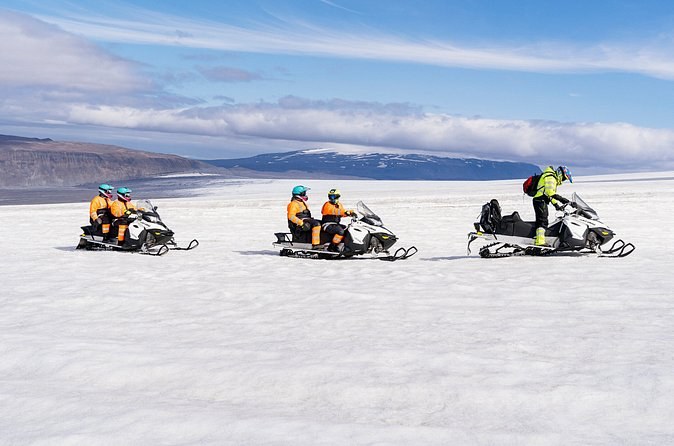
Into the Glacier Combo: Snowmobiling + Langjokull Ice Cave
The one fare that rides the ice cap and walks inside the tunnel the same day.
From $299 per person
Check Availability